

Support Vector Machines (SVM) are a powerful yet flexible type of supervised machine learning algorithm, primarily used for classification and regression tasks. SVM works by mapping data to a high-dimensional feature space so that even complex problems can be handled effectively. In tech interviews, a solid understanding of SVM demonstrates a candidate’s competency in machine learning, optimization, and their ability to handle high-dimensional data.
SVM Fundamentals
- 1.
What is a Support Vector Machine (SVM) in Machine Learning?
Answer:The Support Vector Machine (SVM) algorithm, despite its straightforward approach, is highly effective in both classification and regression tasks. It serves as a robust tool in the machine learning toolbox because of its ability to handle high-dimensional datasets, its generalization performance, and its capability to work well with limited data points.
How SVM Works in Simple Terms
Think of an SVM as a boundary setter in a plot, distinguishing between data points of different classes. It aims to create a clear “gender divide,” and in doing so, it selects support vectors that are data points closest to the decision boundary. These support vectors influence the placement of the boundary, ensuring it’s optimized to separate the data effectively.
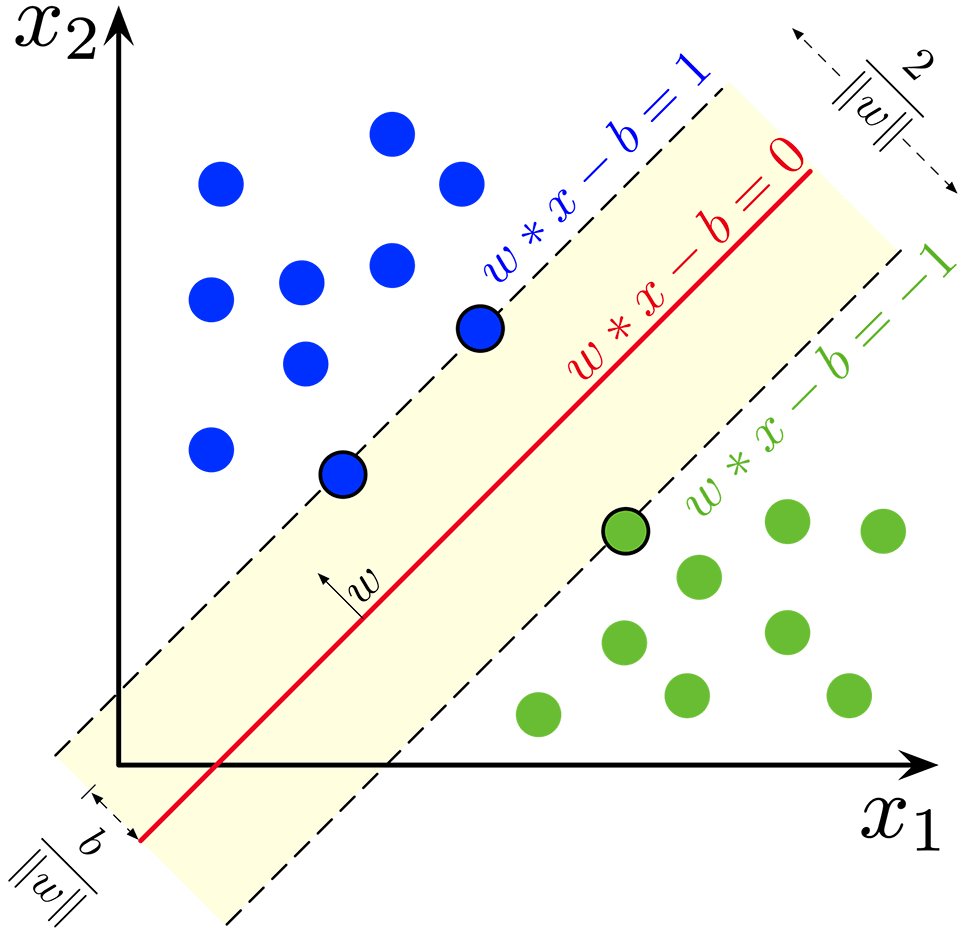
- Hyperplane: In a two-dimensional space, a hyperplane is a straight line. In higher dimensions, it becomes a plane.
- Margin: The space between the closest data points (support vectors) and the hyperplane.
The optimal hyperplane is the one that maximizes this margin. This concept is known as maximal margin classification.
Core Principles
Linear Separability
SVMs are designed for datasets where the data points of different classes can be separated by a linear boundary.
For non-linearly separable datasets, SVMs become more versatile through approaches like kernel trick which introduces non-linearity to transform data into a higher-dimensional space before applying a linear classifier.
Loss Functions
- Hinge Loss: SVMs utilize a hinge loss function that introduces a penalty when data points fall within a certain margin of the decision boundary. The goal is to correctly classify most data points while keeping the margin wide.
- Regularization: Another important aspect of SVMs is regularization, which balances between minimizing errors and maximizing the margin. This leads to a unique and well-defined solution.
Mathematical Foundations
An SVM minimizes the following loss function, subject to constraints:
Here, is the penalty parameter that sets the trade-off between minimizing the norm of the weight vector and minimizing the errors. Larger values lead to a smaller margin and more aggressive classification.
- 2.
Can you explain the concept of hyperplane in SVM?
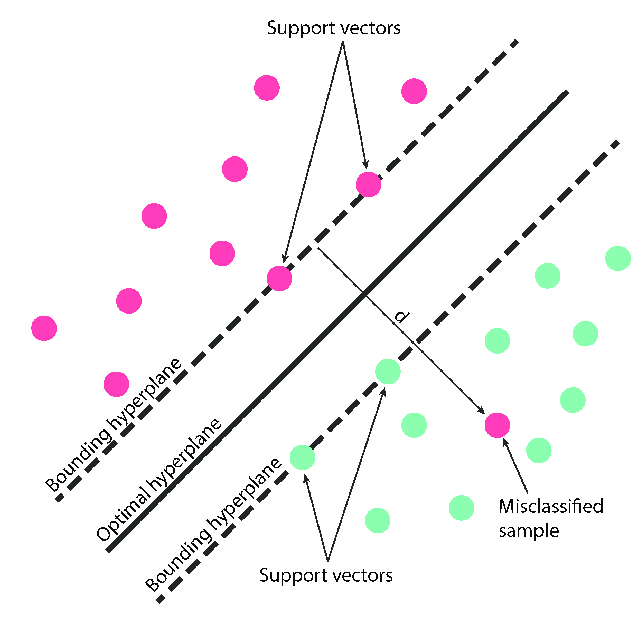
Answer:A hyperplane in an -dimensional space for an SVM classifier can be defined as either a line (), a plane (), or a -dimensional subspace (). Its role in the classifier is to best separate different classes of data points.
Equation of a Hyperplane
In a 2D space, the equation of a hyperplane is:
where is the normal vector to the hyperplane, is the bias term, and is a point on the plane. This equation is often represented using the inner product:
In the case of a linearly separable dataset, the labeled support vectors lie on the decision boundary, and is perpendicular to it.
Example: 2D Space
In a 2D space, the equation of a hyperplane is:
For example, for a hyperplane given by and , its equation becomes:
Here, the hyperplane is a line.
Example: 3D Space
In a 3D space, the equation of a hyperplane is:
For example, for a hyperplane given by and , its equation becomes:
Here, the hyperplane is a plane.
Extending to Higher Dimensions
The equation of a hyperplane in an -dimensional space follows a similar pattern, with components in and terms in the equation.
Here, the hyperplane is an dimensional subspace.
Dual Representation and Kernel Trick
While the primal representation of SVM uses the direct equation of the hyperplane, the dual representation typically employs a kernel function to map the input to a higher-dimensional space. This approach avoids the need to explicitly compute the normal vector and makes use of the inner products directly.
- 3.
What is the maximum margin classifier in the context of SVM?
Answer:The Maximum Margin Classifier is the backbone of Support Vector Machines (SVM). This classifier selects a decision boundary that maximizes the margin between the classes it separates. Unlike traditional classifiers, which seek a boundary that best fits the data, the SVM finds a boundary with the largest possible buffer zone between classes.
How it Works
Representing the decision boundary as a line, the classifier seeks to construct the “widest road” possible between points of the two classes. These points, known as support vectors, define the margin.
The goal is to find an optimal hyperplane that separates the data while maintaining the largest possible margin. Mathematically expressed:
Here, represents the vector perpendicular to the hyperplane, and is a constant term.
Visual Representation
The decision boundary, which is normalized to , is denoted by the innermost dashed line. The parallel solid lines are lines of the form .
Misclassification Tolerance
The SVM also allows for a soft margin, introducing a regularization parameter . This accounts for noisy or overlapping data by permitting a certain amount of misclassification. The margin is optimized to strike a balance between large margins, which are less tolerant of misclassification, and smaller margins, which are more forgiving.
Here, represents the degree to which the -th point lies on the wrong side of the margin. By minimizing this term, the model aims to reduce misclassifications.
Practical Applications
- Text Classification: SVMs with maximum margin classifiers are proficient in distinguishing spam from legitimate emails.
- Image Recognition: SVMs help in categorizing images by detecting edges, shapes, or patterns.
- Market Segmentation: SVMs assist in recognizing distinct customer groups based on various metrics for targeted marketing.
- Biomedical Studies: They play a role in the classification of biological molecules, for example, proteins.
Training the Model
To simplify, the model training aims to minimize the value:
This minimization task is executed using quadratic programming techniques, leading to an intricate but optimized hyperplane.
- 4.
What are support vectors and why are they important in SVM?
Answer:Support vectors play a central role in SVM, dictating the classifier’s decision boundary. Let’s see why they’re crucial.
Big Picture
- Smart Learning: SVMs focus on data points close to the boundary that are the most challenging to classify. By concentrating on these points, the model becomes less susceptible to noise in the data.
- Computational Efficiency: Because the classifier is based only on the support vectors, predictions are faster. In some cases, most of the training data is not considered in the decision function. This is particularly useful in scenarios with large datasets.
Selection Method
During training, the SVM algorithm identifies support vectors from the entire dataset using a dual optimization strategy, called Lagrange multipliers. These vectors possess non-zero Lagrange multipliers, or dual coefficients, allowing them to dictate the decision boundary.
Effective Decision Boundary
The decision boundary of an SVM is entirely determined by the support vectors that lie closest to it. All other data points are irrelevant to the boundary.
This relationship can be expressed as:
Where:
- iterates over the support vectors
- represents the number of support vectors
- and are the dual coefficients and the corresponding class labels, respectively
- is the kernel function
- is the bias term
- 5.
Discuss the difference between linear and non-linear SVM.
Answer:Support Vector Machines (SVMs) are powerful supervised learning algorithms that can be used for both classification and regression tasks. One of their key strengths is their ability to handle both linear and non-linear relationships.
Formulation
- Linear SVM: Maximizes the margin between the two classes, where the decision boundary is a hyperplane.
- Non-Linear SVM: Applies kernel trick which implicitly maps data to a higher dimensional space where a separating hyperplane might exist.
Mathematical Underpinnings
Linear SVM
For linearly separable data, the decision boundary is defined as:
where is the weight vector, is the bias, and is the input vector.
The margin (i.e., the distance between the classes and the decision boundary) is:
Optimizing linear SVMs involves maximizing this margin.
Non-Linear SVM
Non-linear SVMs apply the kernel trick, which allows them to indirectly compute the dot product of input vectors in a higher-dimensional space.
The decision boundary is given by:
where is the kernel function.
Code Example: Linear and Non-Linear SVMs
Here is the Python code:
# Linear SVM from sklearn.svm import SVC linear_svm = SVC(kernel='linear') linear_svm.fit(X_train, y_train) # Non-Linear SVM with RBF kernel rbf_svm = SVC(kernel='rbf') rbf_svm.fit(X_train, y_train) - 6.
How does the kernel trick work in SVM?
Answer:To better understand how the Kernel Trick in SVM operates, let’s start by reviewing a typical linear SVM representation.
Linear SVM: Primal and Dual Formulations
The primal formulation:
where the first part of the above equation is the regularization term and the second part is the loss function.
We can write the Lagrangian for the constrained optimization problem as follows:
where and are Lagrange multipliers. After taking the partial derivatives of the above equation with respect to , , and and setting them to , one gets the primal form of the problem.
The dual expression has the form:
where are the input data points, and are their corresponding output labels.
Entering the Kernel Space
Now, let’s consider the dual solution of the linear SVM problem in terms of the input data:
where is the optimized weight vector, are the corresponding Lagrange multipliers, and are the data-point vectors of the two possible labels.
Using the Kernel Trick, we can rephrase entirely in terms of the kernel function , avoiding the need to explicitly compute . This is highly advantageous when the feature space is high-dimensional or even infinite.
The kernelized representation of simplifies to:
where are the transformed data points in the feature space.
Such a transformation allows the algorithm to operate in a higher-dimensional “kernel” space without explicitly mapping the data to that space, effectively utilizing the inner products in the transformed space.
Practical Implementation
By implementing the kernel trick, the decision function becomes:
where denotes the kernel function.
The kernel trick thus enables SVM to fit nonlinear decision boundaries by employing various kernel functions, including:
- Linear (no transformation):
- Polynomial:
- RBF:
- Sigmoid:
Code Example: Applying Kernels with
sklearnHere is the Python code:
from sklearn.svm import SVC # Initializing SVM with various kernel functions svm_linear = SVC(kernel='linear') svm_poly = SVC(kernel='poly', degree=3, coef0=1) svm_rbf = SVC(kernel='rbf', gamma=0.7) svm_sigmoid = SVC(kernel='sigmoid', coef0=1) # Fitting the models svm_linear.fit(X, y) svm_poly.fit(X, y) svm_rbf.fit(X, y) svm_sigmoid.fit(X, y) - 7.
What kind of kernels can be used in SVM and give examples of each?
Answer:The strength of Support Vector Machines (SVMs) comes from their ability to work in high-dimensional spaces while requiring only a subset of training data points, known as support vectors.
Available SVM Kernels
- Linear Kernel: Ideal for linearly separable datasets.
- Polynomial Kernel: Suited for non-linear data and controlled by a parameter .
- Radial Basis Function (RBF) Kernel: Effective for non-linear, separable data and influenced by a parameter .
- Sigmoid Kernel: Often used in binary classification tasks, especially with neural networks.
While Linear Kernel is the simplest, RBF is the most versatile and widely used.
Code Example: SVM Kernels
Here is the Python code:
from sklearn import datasets from sklearn.model_selection import train_test_split from sklearn.preprocessing import StandardScaler from sklearn.svm import SVC import numpy as np # Load dataset iris = datasets.load_iris() X = iris.data y = iris.target # Make it binary X = X[y != 0] y = y[y != 0] # Split dataset X_train, X_test, y_train, y_test = train_test_split(X, y, test_size=0.2, random_state=42) # Scale the features scaler = StandardScaler() X_train = scaler.fit_transform(X_train) X_test = scaler.transform(X_test) # Train and evaluate with different kernels kernels = ['linear', 'poly', 'rbf', 'sigmoid'] for k in kernels: print(f"Evaluating with {k} kernel") clf = SVC(kernel=k, random_state=42) clf.fit(X_train, y_train) acc = clf.score(X_test, y_test) print(f"Accuracy: {np.round(acc, 4)}") - 8.
Can you explain the concept of a soft margin in SVM and why it’s used?
Answer:The soft margin technique in Support Vector Machines (SVM) allows for a margin that is not hard or strict. This can be beneficial when the data is not perfectly separable. The “C” parameter is instrumental in controlling the soft margin, also known as the regularization parameter.
When to Use a Soft Margin
In practical settings, datasets are often not perfectly linearly separable. In such cases, a hard margin (RBF kernel for example) can lead to overfitting and degraded generalization performance. The soft margin, in contrast, can handle noise and minor outliers more gracefully.
The Soft Margin Mechanism
Rather than seeking the hyperplane that maximizes the margin without any misclassifications (as in a hard margin), a soft margin allows some data points to fall within a certain distance from the separating hyperplane.
The choice of which points can be within this “soft” margin is guided by the concept of slack variables, denoted by .
Slack Variables
In the context of the soft margin, slack variables are used to quantify the classification errors and their deviation from the decision boundary. Mathematically, the margin for each training point is , and the classification is correct if .
The goal is to find the optimal hyperplane while keeping the sum of slack variables () small. The soft margin problem, therefore, formulates as an optimization task that minimizes:
This formulation represents a trade-off between maximizing the margin and minimizing the sum of the slack variables ( is the regularization parameter).
Code Example: Soft Margin and Slack Variables
Here is the Python code:
from sklearn import datasets from sklearn.svm import SVC import numpy as np # Generate a dataset that's not linearly separable X, y = datasets.make_moons(noise=0.3, random_state=42) # Fit a hard margin (linear kernel) SVM # Notice the error; the hard margin cannot handle this dataset svm_hard = SVC(kernel="linear", C=1e5) svm_hard.fit(X, y) # Compare with a soft margin (linear kernel) SVM svm_soft = SVC(kernel="linear", C=0.1) # Using a small C for a more soft margin svm_soft.fit(X, y) # Visualize the decision boundary for both # (Visual interface can better demonstrate the effect of C) - 9.
How does SVM handle multi-class classification problems?
Answer:Support Vector Machines (SVMs) are inherently binary classifiers, but they can effectively perform multi-class classification using a suite of strategies.
SVM for Multi-Class Classification
-
One-Vs.-Rest (OvR):
- Each class has its own classifier which is trained to distinguish that class from all others. During prediction, the class with the highest confidence from their respective classifiers is chosen.
-
One-Vs.-One (OvO):
- For classes, classifiers are trained, each distinguishing between two classes. The class that “wins” the most binary classifications is the predicted class.
-
Decision-Tree-SVM Hybrid:
- Builds a decision tree on top of SVMs to handle multi-class problems. Each leaf in the tree represents a class and the path from the root to the leaf gives the decision.
-
Error-Correcting Output Codes (ECOC):
- Decomposes the multi-class problem into a series of binary ones. The codewords for the binary classifiers are generated such that they correct errors more effectively.
-
Direct Multi-Class Approaches: Modern SVM libraries often have built-in algorithms that allow them to directly handle multi-class problems without needing to decompose them into multiple binary classification problems.
Code Example: Multi-Class SVM Using Different Strategies
Here is the Python code:
from sklearn.svm import SVC from sklearn.multiclass import OneVsRestClassifier, OneVsOneClassifier from sklearn.tree import DecisionTreeClassifier from sklearn.datasets import load_iris from sklearn.model_selection import train_test_split from sklearn.metrics import accuracy_score, classification_report # Load the Iris dataset iris = load_iris() X, y = iris.data, iris.target # Split the data into training and testing sets X_train, X_test, y_train, y_test = train_test_split(X, y, test_size=0.3, random_state=42) # Initialize different multi-class SVM classifiers svm_ovo = SVC(decision_function_shape='ovo') svm_ovr = SVC(decision_function_shape='ovr') svm_tree = DecisionTreeClassifier() svm_ecoc = SVC(decision_function_shape='ovr') # Initialize the OvR and OvO classifiers ovr_classifier = OneVsRestClassifier(SVC()) ovo_classifier = OneVsOneClassifier(SVC()) # Train the classifiers svm_ovo.fit(X_train, y_train) svm_ovr.fit(X_train, y_train) svm_tree.fit(X_train, y_train) svm_ecoc.fit(X_train, y_train) ovr_classifier.fit(X_train, y_train) ovo_classifier.fit(X_train, y_train) # Evaluate each classifier classifiers = [svm_ovo, svm_ovr, svm_tree, svm_ecoc, ovr_classifier, ovo_classifier] for clf in classifiers: y_pred = clf.predict(X_test) accuracy = accuracy_score(y_test, y_pred) print(f"Accuracy using {clf.__class__.__name__}: {accuracy:.2f}") # Using the prediction approach for different classifiers print("\nClassification Report using different strategies:") for clf in classifiers: y_pred = clf.predict(X_test) report = classification_report(y_test, y_pred, target_names=iris.target_names) print(f"{clf.__class__.__name__}:\n{report}") -
- 10.
What are some of the limitations of SVMs?
Answer:While Support Vector Machines (SVMs) are powerful tools, they do come with some limitations.
Computational Complexity
The primary algorithm for finding the optimal hyperplane, the Sequential Minimal Optimization algorithm, has a worst-case time complexity of . This can make training time prohibitively long for large datasets.
Parameter Selection Sensitivity
SVMs can be sensitive to the choice of hyperparameters, such as the regularization parameter © and the choice of kernel. It can be a non-trivial task to identify the most appropriate values, and different datasets might require different settings to achieve the best performance, potentially leading to overfitting or underfitting.
Memory and CPU Requirements
The SVM fitting procedure generally involves storing the entire dataset in memory. Moreover, the prediction process can be CPU-intensive due to the need to calculate the distance of all data points from the decision boundary.
Handling Non-Linear Data
SVMs, in their basic form, are designed to handle linearly separable data. While kernel methods can be employed to handle non-linear data, interpreting the results in such cases can be challenging.
Lack of Probability Estimates
While some SVM implementations provide tools to estimate probabilities, this is not the algorithm’s native capability.
Difficulty with Large Datasets
Given their resource-intensive nature, SVMs are not well-suited for very large datasets. Additionally, the absence of a built-in method for feature selection means that feature engineering needs to be comprehensive before feeding the data to an SVM model.
Limited Multiclass Applications Without Modifications
SVMs are fundamentally binary classifiers. While there are strategies such as One-Vs-Rest and One-Vs-One to extend their use to multi-class problems, these approaches come with their own sets of caveats.
Uninspired Use of Kernel Functions
Selecting the optimal kernel function can be challenging, especially without a good understanding of the data’s underlying structure.
Sensitive to Noisy or Overlapping Datasets
SVMs can be adversely affected by noisy data or datasets where classes are not distinctly separable. This behavior can lead to poor generalization on unseen data.
 Explore all 70 SVM questions and more Machine Learning topics
SVM Mathematics and Optimization
- 11.
Describe the objective function of the SVM.
Answer:The Support Vector Machine (SVM) employs a hinge loss that serves as its objective function.
Objective Function: Hinge Loss
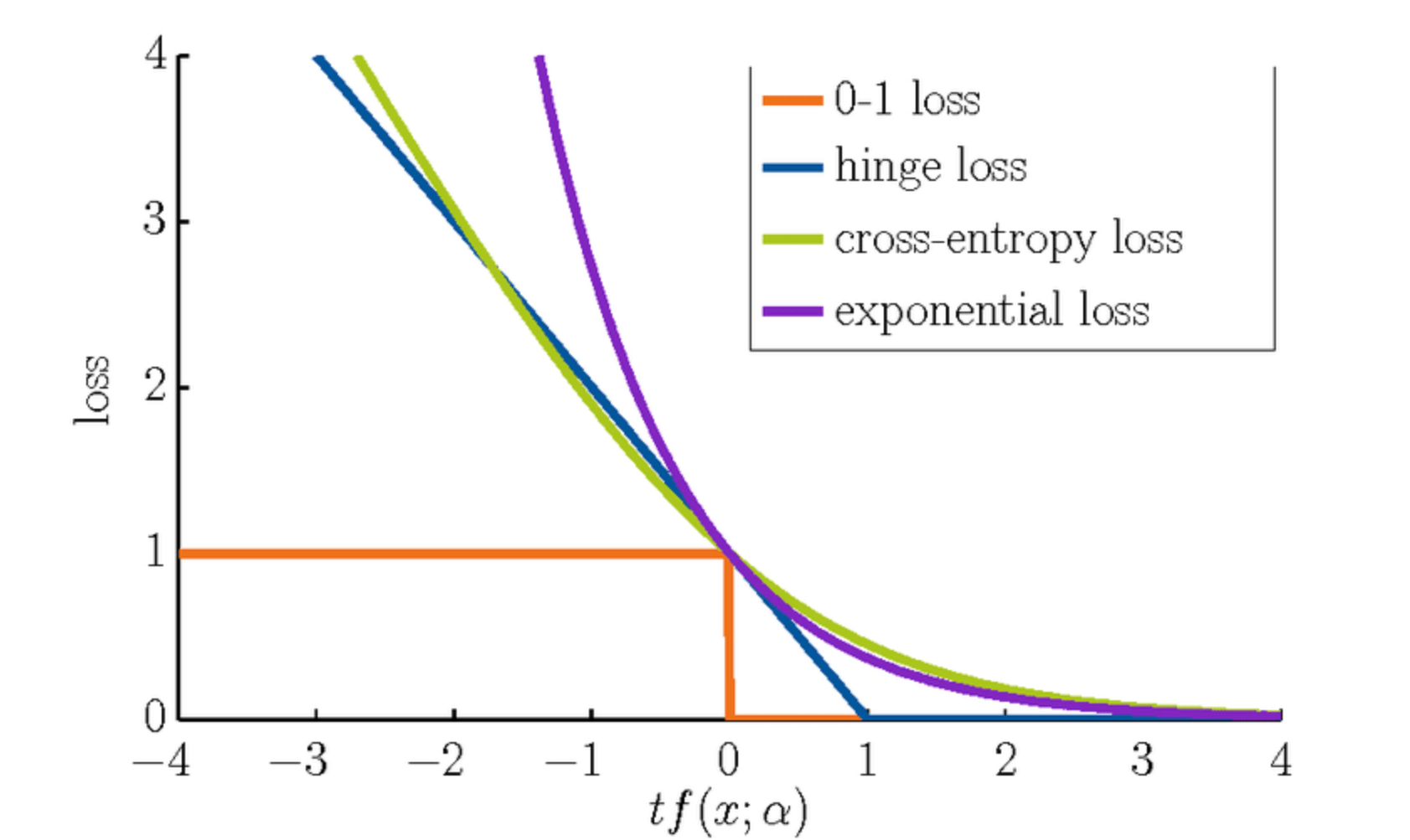
The hinge loss is a piecewise function, considering the margin’s distance to the correct classification for .
And particularly in the SVM context:
Where:
- represents the product .
- is the actual class label, either -1 or 1.
- is the decision function or score computed by the SVM model for data point .
Visualization of Hinge Loss
The hinge loss is graphically characterized by a zero loss for values , and a sloping linear loss for values . This gives the model a “soft boundary” for misclassified points.
Mathematical Formulation: Hinge Loss
From a mathematical standpoint, the hinge loss function for a single data point can be expressed as:
The Empirical Risk Minimization (ERM) of the SVM involves the following optimization problem of minimizing the sum of hinge losses over all data points:
Subject to:
Where:
- is a regularization parameter, balancing margin maximization with training errors.
- is the weight vector.
- is the bias term.
Code Example: Hinge Loss
Here is the Python code:
import numpy as np def hinge_loss(y, f_x): return np.maximum(0, 1 - y * f_x) # Example calculation y_true = 1 f_x = 0.5 loss = hinge_loss(y_true, f_x) print(f"Hinge loss for f(x) = {f_x} and true label y = {y_true}: {loss}") - 12.
What is the role of the Lagrange multipliers in SVM?
Answer:The Lagrange multipliers, central to the concept of Support Vector Machines (SVM), are introduced to handle the specifics of constrained optimization.
Key Components of SVM
-
Optimization Objective: SVM aims to maximize the margin, which involves balancing the margin width and the training error. This is formalized as a quadratic optimization problem.
-
Decision Boundary: The optimized hyperplane produced by SVM acts as the decision boundary.
-
Support Vectors: These are the training data points that lie closest to the decision boundary. The classifier’s performance is dependent only on these points, leading to the sparse solution behavior.
Lagrange Multipliers in SVM
The use of Lagrange multipliers is a defining characteristic of SVMs, offering a systematic way to transform a constrained optimization problem into an unconstrained one. This transformation is essential to construct the linear decision boundary and simultaneously determine the set of points that contribute to it.
Lagrangian Formulation for SVM
Let’s define the key terms:
- and are the parameters of the hyperplane.
- are non-negative slack variables.
The primal problem can be formulated as:
The associated Lagrangian function is:
Terms involving (introduced to handle the non-negativity of ) and the 's define the dual problem, and the solution to this dual problem provides the support vectors.
By setting the derivatives of with respect to , , and to zero, and then using these results to eliminate and from the expression for , one arrives at the dual optimization problem, which effectively decouples the optimization of the decision boundary from the determination of the support vectors.
-
- 13.
Explain the process of solving the dual problem in SVM optimization.
Answer:Solving the Dual Problem when optimizing a Support Vector Machine (SVM) allows for more efficient computation and computational tractability through the use of optimization techniques like the Lagrange multipliers and Wolfe dual.
Key Concepts
-
Lagrange Duality: The process aims to convert the primal (original) optimization problem into a dual problem, which is simpler and often more computationally efficient. This is achieved by introducing Lagrange multipliers, which are used to form the Lagrangian.
-
Karush-Kuhn-Tucker (KKT) Conditions: The solution to the dual problem also satisfies the KKT conditions, which are necessary for an optimal solution to both the primal and dual problems.
-
Wolfe Duality: Works in conjunction with KKT conditions to ensure that the dual solution provides a valid lower bound to the primal solution.
Steps in the Optimization Process
-
Formulate the Lagrangian: Combine the original optimization problem with the inequality constraints using Lagrange multipliers.
-
Compute Partial Derivatives: Calculate the partial derivatives of the Lagrangian with respect to the primal variables, and set them equal to zero.
-
Determine KKT Violations: At the optimum, the differentiability conditions should be met. Check for KKT violations, such as non-negativity of the Lagrange multipliers and complementary slackness.
-
Simplify the Dual Problem:
- Substitute the primal variables using the KKT optimality conditions.
- Arrive at the expression for the Wolfe dual, which provides a lower bound to the primal objective function.
-
Solve the Dual Problem: Often using mathematical techniques or computational tools to find the optimal dual variables, or Lagrange multipliers, which correspond to optimal separation between classes.
-
Recover the Primal Variables: Using the KKT conditions, one can reconstruct the solution to the primal problem, typically involving the support vectors.
Code Example: Simplifying the Dual Formulation
Here is the Python code:
import numpy as np from sklearn import datasets from sklearn.preprocessing import StandardScaler from sklearn.svm import SVC # Load Iris dataset iris = datasets.load_iris() X = iris.data y = iris.target # Feature scaling and data preparation scaler = StandardScaler().fit(X) X = scaler.transform(X) # Fit linear SVM svm = SVC(kernel='linear', C=1.0).fit(X, y) # Computing support vectors and dual coefficients support_vectors = svm.support_vectors_ dual_coefficients = np.abs(svm.dual_coef_) # Recovering the primal coefficients and intercept primal_coefficients = np.dot(dual_coefficients, support_vectors) intercept = svm.intercept_ # Printing results print("Support Vectors:\n", support_vectors) print("Dual Coefficients:\n", dual_coefficients) print("Primal Coefficients:", primal_coefficients) print("Intercept:", intercept) -
- 14.
How do you choose the value of the regularization parameter © in SVM?
Answer:Choosing the regularization parameter in SVM entails a trade-off between a more aligned decision boundary with the data (lower ) and minimizing the training error by allowing more misclassified points (higher ). This is done using the Hyperparameter Tuning mechanism.
Types of Hyperparameters
-
Model Parameters: Learned from data during training, such as weights in linear regression.
-
Hyperparameters: Set before the learning process and are not learned from data.
Why it is Necessary
Optimizing model hyperparameters like is essential to ensure that your model is both accurate and generalizes well to new, unseen data.
Hyperparameters for SVM
-
: Trades off correct classification of training points against the maximal margin. A smaller encourages a larger margin.
-
in RBF Kernel: Sets the ‘spread’ of the kernel. Higher values lead to tighter fits of the training data.
-
Choice of Kernel: Modifies the optimization problem.
-
Kernel Parameters: Each kernel may have specific hyperparameters.
Optimization Methods
-
Grid Search: Checks all possible hyperparameter combinations, making it exhaustive but computationally expensive.
-
Random Search: Randomly samples from a hyperparameter space, which can be more efficient and effective in high dimensions.
-
Bayesian Optimization: Utilizes results of past evaluations to adaptively pick the next set of hyperparameters. This often results in quicker convergence.
-
Genetic Algorithms: Simulates natural selection to find the best hyperparameters over iterations.
Model Evaluation and Hyperparameter Tuning
-
Train-Validation-Test Split: Used to manage overfitting when tuning hyperparameters.
-
Cross-Validation: A more robust method for tuning hyperparameters.
Performance Metrics for Hyperparameter Tuning
- Accuracy: The percentage of correct predictions.
- Precision: The ability of the classifier not to label as positive a sample that is negative.
- Recall: The ability of the classifier to find all the positive samples.
- F1 Score: The weighted average of Precision and Recall.
Code Example: Grid Search
Here is the code:
from sklearn.model_selection import GridSearchCV from sklearn import svm, datasets # Load dataset iris = datasets.load_iris() X, y = iris.data, iris.target # Specify the hyperparameter space param_grid = {'C': [0.1, 1, 10, 100]} # Instantiate the model svc = svm.SVC() # Set up the grid search grid_search = GridSearchCV(svc, param_grid, cv=5) # Perform the grid search grid_search.fit(X, y) # Get the best parameter best_C = grid_search.best_params_['C'] print(f"The best value of C is {best_C}") -
- 15.
Explain the concept of the hinge loss function.
Answer:The hinge loss function is a key element in optimizing Support Vector Machines (SVMs). It’s a non-linear loss function that’s singularly focused on classification rather than probability. In mathematical terms, the hinge loss function is defined as:
Here, is the raw decision score, and is the true class label, which is either for the negative class or for the positive class.
Geometric Interpretation
The hinge loss function corresponds to the margin distance between the decision boundary and the support vectors:
- When a point is correctly classified and beyond the margin, the hinge loss is zero.
- When a point is within the margin, the classifier is penalized proportionally to how close the point is to the margin, ensuring the decision boundary separates the classes.
- If a point is misclassified, the hinge loss is positive and directly proportional to the distance from the decision boundary.
This geometric interpretation aligns with the goal of SVMs: to find the hyperplane that maximizes the margin while minimizing the hinge loss.

%20--%3e%3csvg%20version='1.1'%20id='Слой_1'%20xmlns='http://www.w3.org/2000/svg'%20xmlns:xlink='http://www.w3.org/1999/xlink'%20x='0px'%20y='0px'%20viewBox='0%200%20101%20101'%20style='enable-background:new%200%200%20101%20101;'%20xml:space='preserve'%3e%3cstyle%20type='text/css'%3e%20.st0{fill:%23FFFFFF;}%20%3c/style%3e%3cpath%20class='st0'%20d='M80.1,90c0.7,0,1.2-0.6,1.2-1.4c0-0.8-0.5-1.4-1.2-1.4H14.8c-2.7,0-4.9-2.5-4.9-5.6V15.2c0-0.8-0.5-1.4-1.2-1.4%20c-0.7,0-1.2,0.6-1.2,1.4v66.3c0,4.7,3.3,8.5,7.3,8.5H80.1z'/%3e%3cpath%20class='st0'%20d='M91.6,11H66.1c-0.7,0-1.2,0.6-1.2,1.4c0,0.8,0.5,1.4,1.2,1.4h22.7L63,43.7l-20.7,1.7l-0.7,0.4L22.4,67.7%20c-0.5,0.4-0.6,1.4-0.2,2c0.4,0.6,1.2,0.7,1.7,0.3c0.1-0.1,0.1-0.1,0.2-0.3l18.6-21.4l20.7-1.7l0.7-0.4l26.2-30.2v26%20c0,0.8,0.5,1.4,1.2,1.4s1.2-0.6,1.2-1.4V12.4C92.8,11.6,92.3,11,91.6,11z'/%3e%3c/svg%3e)






%20--%3e%3csvg%20version='1.1'%20id='Layer_1'%20xmlns='http://www.w3.org/2000/svg'%20xmlns:xlink='http://www.w3.org/1999/xlink'%20x='0px'%20y='0px'%20viewBox='0%200%2044.5%2044.5'%20style='enable-background:new%200%200%2044.5%2044.5;'%20xml:space='preserve'%3e%3cstyle%20type='text/css'%3e%20.st0{fill:none;stroke:%23202020;stroke-width:1.498;stroke-linecap:round;stroke-linejoin:round;stroke-miterlimit:3.994;}%20.st1{fill:none;stroke:%23202020;stroke-width:1.498;stroke-linecap:round;stroke-miterlimit:10.005;}%20%3c/style%3e%3cpath%20class='st0'%20d='M11.4,28l11-11.5L33.1,28'/%3e%3ccircle%20class='st1'%20cx='22.2'%20cy='22.2'%20r='21.5'/%3e%3c/svg%3e)