

Hash Table is a data structure that uses a hash function to map keys to their associated values, optimizing for efficient access and retrieval. The concept of a hash table is a cornerstone of data management and a common subject in technical interviews. It tests a candidate’s understanding of key-value storage and their capability to analyze and reduce algorithm complexity in data retrieval tasks.
Basic Hash Table Concepts
- 1.
What is a Hash Table?
Answer:A Hash Table, also known as a Hash Map, is a data structure that provides a mechanism to store and retrieve data based on key-value pairs.
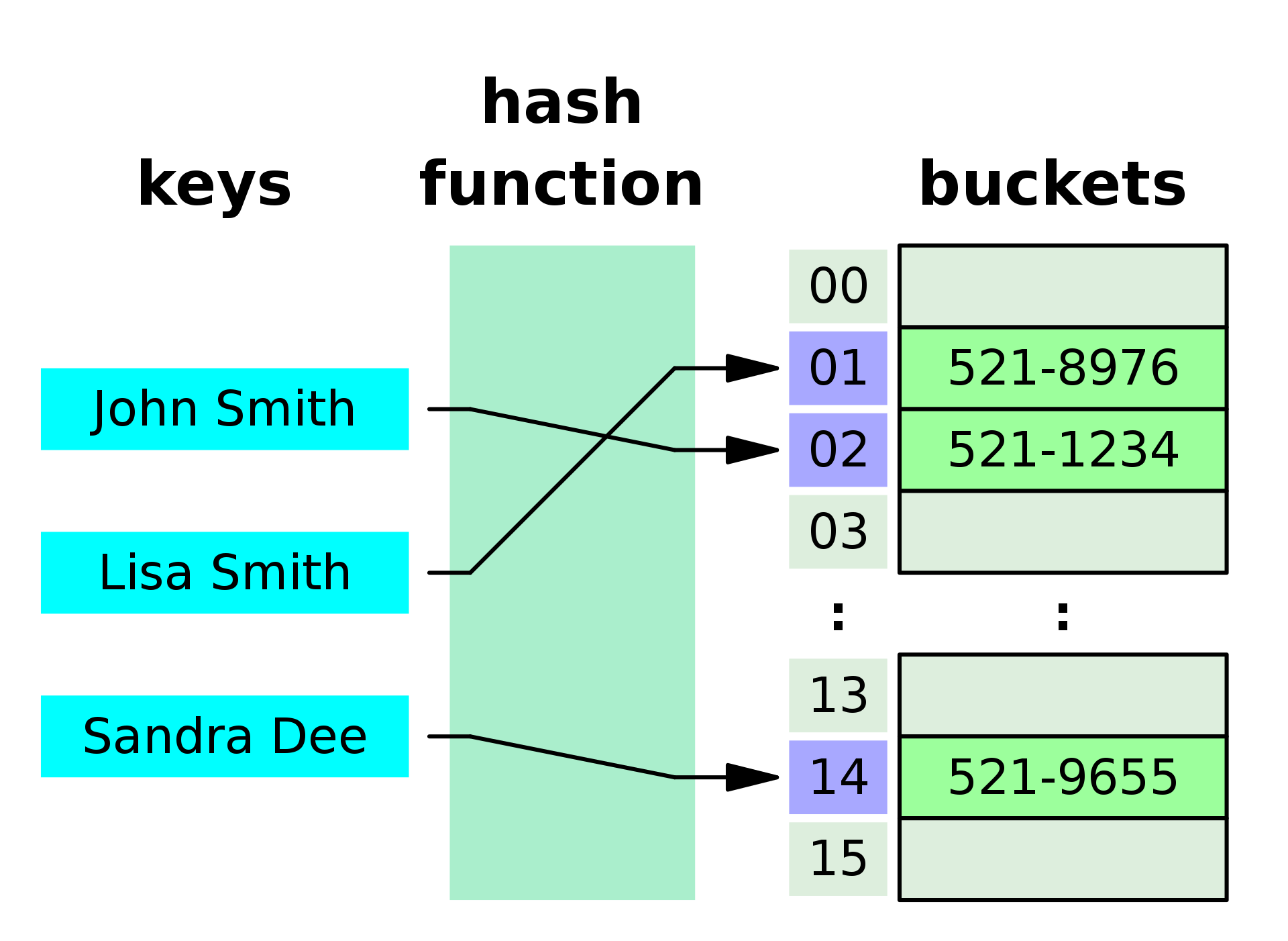
It is an associative array abstract data type where the key is hashed, and the resulting hash value is used as an index to locate the corresponding value in a bucket or slot.
Key Features
- Unique Keys: Each key in the hash table maps to a single value.
- Dynamic Sizing: Can adjust its size based on the number of elements.
- Fast Operations: Average time complexity for most operations is .
Visual Representation
Core Components
Hash Function
The hash function converts each key to a numerical hash value, which is then used to determine the storage location, or “bucket.”
Buckets
Buckets are containers within the hash table that hold the key-value pairs. The hash function aims to distribute keys uniformly across buckets to minimize collisions.
Collision Handling
- Open-Addressing: Finds the next available bucket if a collision occurs.
- Chaining: Stores colliding keys in a linked list within the same bucket.
Complexity Analysis
- Time Complexity: - average and best-case, - worst-case.
- Space Complexity:
Code Example: Hash Table
Here is the Python code:
# Initialize a hash table hash_table = {} # Add key-value pairs hash_table['apple'] = 5 hash_table['banana'] = 2 hash_table['cherry'] = 3 # Retrieve a value print(hash_table['apple']) # Output: 5 # Update a value hash_table['banana'] = 4 # Remove a key-value pair del hash_table['cherry'] - 2.
What is Hashing?
Answer:Hashing is a method that maps data to fixed-size values, known as hash values, for efficient storage and retrieval. A hash function generates these values, serving as the data’s unique identifier or key.
Key Features
- Speed: Hashing offers constant-time complexity for data operations.
- Data Integrity: A good hash function ensures even minor data changes will yield different hash values.
- Security: Cryptographic hashes are essential in secure data transmission.
- Collision Management: While hash collisions can occur, they are manageable and typically rare.
Hash Functions and Hash Values
A hash function generates a fixed-size hash value, serving as the data’s unique identifier or key for various applications like data indexing and integrity checks. Hash values are typically represented as hexadecimal numbers.
Key Characteristics
- Deterministic: The same input will always produce the same hash value.
- Fixed-Length Output: Outputs have a consistent length, making them suitable for data structures like hash tables.
- Speed: Hash functions are designed for quick computation.
- One-Way Functionality: Reconstructing the original input from the hash value should be computationally infeasible.
- Avalanche Effect: Small input changes should result in significantly different hash values.
- Collision Resistance: While it’s difficult to completely avoid duplicate hash values for unique inputs, well-designed hash functions aim to minimize this risk.
Popular Hashing Algorithms
- MD5: Obsolete due to vulnerabilities.
- SHA Family:
- SHA-1: Deprecated; collision risks.
- SHA-256: Widely used in cryptography.
Practical Applications
- Databases: For quick data retrieval through hash indices.
- Distributed Systems: For data partitioning and load balancing.
- Cryptography: To ensure data integrity.
- Caching: For efficient in-memory data storage and access.
Code Example: SHA-256 with
hashlibHere is the Python code:
import hashlib def compute_sha256(s): hasher = hashlib.sha256(s.encode()) return hasher.hexdigest() print(compute_sha256("Hello, World!")) - 3.
Explain the difference between Hashing and Hash Tables.
Answer:When discussing Hashing and Hash Tables, it’s crucial to recognize that one is a technique while the other is a data structure. Here’s a side-by-side comparison:
Key Distinctions
Definition
- Hashing: A computational technique that converts input (often a string) into a fixed-size value, referred to as a hash value.
- Hash Tables: A data structure that utilizes hash values as keys to efficiently store and retrieve data in memory.
Primary Function
- Hashing: To generate a unique identifier (hash value) for a given input, ensuring consistency and rapid computation.
- Hash Tables: To facilitate quick access to data by mapping it to a hash value, which determines its position in the table.
Application Areas
- Hashing: Common in cryptography for secure data transmission, data integrity checks, and digital signatures.
- Hash Tables: Used in programming and database systems to optimize data retrieval operations.
Inherent Complexity
- Hashing: Focuses solely on deriving a hash value from input data.
- Hash Tables: Incorporates mechanisms to manage issues like hash collisions (when two distinct inputs produce the same hash value) and may also involve dynamic resizing to accommodate growing datasets.
Operational Performance
- Hashing: Producing a hash value is typically an operation, given a consistent input size.
- Hash Tables: On average, operations such as data insertion, retrieval, and deletion have time complexity, although worst-case scenarios can degrade performance.
Persistence
- Hashing: Transient in nature; once the hash value is generated, the original input data isn’t inherently stored or preserved.
- Hash Tables: Persistent storage structure; retains both the input data and its corresponding hash value in the table.
- 4.
Provide a simple example of a Hash Function.
Answer:The parity function can serve as a rudimentary example of a hash function. It takes a single input, usually an integer, and returns either
0or1based on whether the input number is even or odd.Properties of the Parity Function
- Deterministic: Given the same number, the function will always return the same output.
- Efficient: Computing the parity of a number can be done in constant time.
- Small Output Space: The output is limited to two possible values,
0or1. - One-Way Function: Given one of the outputs (
0or1), it is impossible to determine the original input.
Code Example: Parity Function
Here is the Python code:
def hash_parity(n: int) -> int:
    if n % 2 == 0:
        return 0
    return 1
Real-World Hash Functions
While the parity function serves as a simple example, real-world hash functions are much more complex. They often use cryptographic algorithms to provide a higher level of security and other features like the ones mentioned below:
- Cryptographic Hash Functions: Designed to be secure against various attacks like pre-image, second-pre-image, and collision.
- Non-Cryptographic Hash Functions: Used for general-purpose applications, data storage, and retrieval.
- Perfect Hash Functions: Provide a unique hash value for each distinct input.
- 5.
How do hash tables work under the hood, specifically in languages like Java, Python, and C++?
Answer:Hash tables are at the core of many languages, such as Java, Python, and C++:
Core Concepts
-
Key Insights: Hash tables allow for fast data lookups based on key values. They use a technique called hashing to map keys to specific memory locations, enabling time complexity for key-based operations like insertion, deletion, and search.
-
Key Mapping: This is often implemented through a hash function, a mathematical algorithm that converts keys into unique integers (hash values or hash codes) within a fixed range. The hash value then serves as an index to directly access the memory location where the key’s associated value is stored.
-
Handling Collisions:
- Challenges: Two different keys can potentially hash to the same index, causing what’s known as a collision.
- Solutions:
- Separate Chaining: Affected keys and their values are stored in separate data structures, like linked lists or trees, associated with the index. The hash table then maps distinct hash values to each separate structure.
- Open Addressing: When a collision occurs, the table is probed to find an alternative location (or address) for the key using specific methods.
Collision Handling in Python, Java, and C++
-
Python
- Data Structure: Python uses an array of pointers to linked lists. Each linked list is called a “bucket” and contains keys that hash to the same index.
hashtab[hash(key) % size].insert(key, val) - Size Dynamics: Python uses dynamic resizing, and its load factor dictates when resizing occurs.
- Data Structure: Python uses an array of pointers to linked lists. Each linked list is called a “bucket” and contains keys that hash to the same index.
-
Java
- Data Structure: The
HashMapclass uses an array of TreeNodes and LinkedLists, converting to trees after a certain threshold. - Size Dynamics: Java also resizes dynamically, triggered when the number of elements exceeds a load factor.
- Data Structure: The
-
C++ (Standard Library)
- Data Structure: Starting from C++11, the standard library
unordered_maptypically implements hash tables as resizable arrays of linked lists. - Size Dynamics: It also resizes dynamically when the number of elements surpasses a certain load factor.
- Data Structure: Starting from C++11, the standard library
Do note that C++ has several that may get used in hash tables, and it also uses separate chaining as a collision avoidance technique.
The Complexity Behind Lookups
While hash tables provide constant-time lookups in the average case, several factors can influence their performance:
- Hash Function Quality: A good hash function distributes keys more evenly, promoting better performance. Collisions, especially frequent or hard-to-resolve ones, can lead to performance drops.
- Load Factor: This is the ratio of elements to buckets. When it gets too high, the structure becomes less efficient, and resizing can be costly. Java and Python automatically manage load factors during resizing.
- Resizing Overhead: Periodic resizing (to manage the load factor) can pause lookups, leading to a one-time performance hit.
-
 Explore all 39 Hash Tables questions and more Data Structures and Algorithms topics
Hash Functions and Collisions
- 6.
What are Hash Collisions?
Answer:In hash functions and tables, a hash collision occurs when two distinct keys generate the same hash value or index. Efficiently addressing these collisions is crucial for maintaining the hash table’s performance.
Causes of Collisions
- Hash Function Limitations: No hash function is perfect; certain datasets may result in more collisions.
- Limited Hash Space: Due to the Pigeonhole Principle, if there are more unique keys than slots, collisions are inevitable.
Collisions Types
- Direct: When two keys naturally map to the same index.
- Secondary: Arising during the resolution of a direct collision, often due to strategies like chaining or open addressing.
Probability
The likelihood of a collision is influenced by the hash function’s design, the number of available buckets, and the table’s load factor.
Worst-case scenarios where all keys collide to the same index, can degrade a hash table’s performance from to .
Strategies for Collision Resolution
- Chaining: Each slot in the hash table contains a secondary data structure, like a linked list, to hold colliding keys.
- Open Addressing: The hash table looks for the next available slot to accommodate the colliding key.
- Cryptographic Hash Functions: These are primarily used to ensure data integrity and security due to their reduced collision probabilities. However, they’re not commonly used for general hash tables because of their slower performance.
Illustrative Example
Consider a hash table that employs chaining to resolve collisions:
Index Keys 3 key1, key2 Inserting a new key that hashes to index 3 causes a collision. With chaining, the new state becomes:
Index Keys 3 key1, key2, key7 Key Takeaways
- Hash Collisions are Inevitable: Due to inherent mathematical and practical constraints.
- Strategies Matter: The efficiency of a hash table can be significantly influenced by the chosen collision resolution strategy.
- Probability Awareness: Being aware of collision probabilities is vital, especially in applications demanding high performance or security.
- 7.
Name some Collision Handling Techniques.
Answer:In hash tables, collisions occur when different keys yield the same index after being processed by the hash function. Let’s look at common collision-handling techniques:
Chaining
How it Works: Each slot in the table becomes the head of a linked list. When a collision occurs, the new key-value pair is appended to the list of that slot.
Pros:
- Simple to implement.
- Handles high numbers of collisions gracefully.
Cons:
- Requires additional memory for storing list pointers.
- Cache performance might not be optimal due to linked list traversal.
Linear Probing
How it Works: If a collision occurs, the table is probed linearly (i.e., one slot at a time) until an empty slot is found.
Pros:
- Cache-friendly as elements are stored contiguously.
Cons:
- Clustering can occur, slowing down operations as the table fills up.
- Deleting entries requires careful handling to avoid creating “holes.”
Double Hashing
How it Works: Uses two hash functions. If the first one results in a collision, the second hash function determines the step size for probing.
Pros:
- Reduces clustering compared to linear probing.
- Accommodates a high load factor.
Cons:
- More complex to implement.
- Requires two good hash functions.
Code Example: Chaining
Here is the Python code:
class Node:
    def __init__(self, key, value):
        self.key = key
        self.value = value
        self.next = None

class HashTableWithChaining:
    def __init__(self, size):
        self.table = [None] * size

    def _hash(self, key):
        return hash(key) % len(self.table)

    def insert(self, key, value):
        index = self._hash(key)
        new_node = Node(key, value)

        # If slot is empty, simply assign it to the new node
        if self.table[index] is None:
            self.table[index] = new_node
            return

        # If slot is occupied, traverse to the end of the chain and append
        current = self.table[index]
        while current:
            if current.key == key:
                current.value = value  # Overwrite if key already exists
                return
            if not current.next:
                current.next = new_node  # Append to the end
                return
            current = current.next

    def get(self, key):
        index = self._hash(key)
        current = self.table[index]
        while current:
            if current.key == key:
                return current.value
            current = current.next
        return None

# Example Usage:

hash_table = HashTableWithChaining(10)
hash_table.insert("key1", "value1")
hash_table.insert("key2", "value2")
hash_table.insert("key3", "value3")
hash_table.insert("key1", "updated_value1")  # Update existing key

print(hash_table.get("key1"))  # Output: updated_value1
print(hash_table.get("key2"))  # Output: value2
Code Example: Linear Probing
Here is the Python code:
class HashTable:
    def __init__(self, size):
        self.table = [None] * size

    def _hash(self, key):
        return hash(key) % len(self.table)

    def insert(self, key, value):
        index = self._hash(key)
        while self.table[index] is not None:
            if self.table[index][0] == key:
                break
            index = (index + 1) % len(self.table)
        self.table[index] = (key, value)

    def get(self, key):
        index = self._hash(key)
        while self.table[index] is not None:
            if self.table[index][0] == key:
                return self.table[index][1]
            index = (index + 1) % len(self.table)
        return None
Code Example: Double Hashing
Here is the Python code:
class DoubleHashingHashTable: def __init__(self, size): self.table = [None] * size def _hash1(self, key): return hash(key) % len(self.table) def _hash2(self, key): return (2 * hash(key) + 1) % len(self.table) def insert(self, key, value): index = self._hash1(key) step = self._hash2(key) while self.table[index] is not None: if self.table[index][0] == key: break index = (index + step) % len(self.table) self.table[index] = (key, value) def get(self, key): index = self._hash1(key) step = self._hash2(key) while self.table[index] is not None: if self.table[index][0] == key: return self.table[index][1] index = (index + step) % len(self.table) return None - 8.
Describe the characteristics of a good hash function.
Answer:A good hash function is fundamental for efficient data management in hash tables or when employing techniques such as hash-based encryption. Here, let’s go through what it means for a hash function to be high-quality.
Key Features
- Deterministic: The function should consistently map the same input to the same hash value.
- Fast Performance: Ideally, the function should execute in time for typical use.
Minimizing Collisions
Collision is the term when two different keys have the same hash value.
- Few collisions: A good hash function minimizes the number of collisions when it is possible.
- Uniformly Distributed Hash Values: Each output hash value or, in the context of a hash table, each storage location should be equally likely for the positive performance of the hash table.
Desirable Behavioral Qualities
- Security Considerations: In the context of cryptographic hash functions, the one-way nature is essential, meaning it is computationally infeasible to invert the hash value.
- Value Independence: Small changes in the input should result in substantially different hash values, also known as the avalanche effect.
Code Example: Basic Hash Function
Here is the Python code:
def basic_hash(input_string):
    '''A simple hash function using ASCII values'''
    hash_val = 0
    for char in input_string:
        hash_val += ord(char)
    return hash_val
This hash function sums up the ASCII values of the characters in
input_stringto get its hash value. While this function is easy to implement and understand, it is not a good choice in practice as it may not meet the characteristics mentioned above.Code Example: Secure Hash Function
Here is the Python code:
import hashlib

def secure_hash(input_string):
    '''A secure hash function using SHA-256 algorithm'''
    hash_object = hashlib.sha256(input_string.encode())
    hash_hex = hash_object.hexdigest()
    return hash_hex
In this example, the
hashliblibrary allows us to implement a cryptographic hash function using the SHA-256 algorithm. This algorithm is characterized by high security and the one-way nature essential for securing sensitive data. - 9.
What is Separate Chaining, and how does it handle collisions?
Answer:Separate Chaining is a collision resolution technique employed in Hash Tables. This method entails maintaining a list of entries, often implemented as a linked list, for each bucket.
Key Benefits
- Effective Collision Handling: It provides a consistent utility irrespective of the number of keys hashed.
- Easy to Implement and Understand: This technique is relatively simple and intuitive to implement.
Procedure Overview
- Bucket Assignment: Each key hashes to a specific “bucket,” which could be a position in an array or a dedicated location in memory.
- Internal List Management: Keys within the same bucket are stored sequentially. Upon a collision, keys are appended to the appropriate bucket.
Search Performances
- Best-Case : The target key is the only entry in its bucket.
- Worst-Case : All keys in the table hash to the same bucket, and a linear search through the list is necessary.
Code Example: Separate Chaining
Here is the Python code:
# Node for key-value storage in the linked list class Node: def __init__(self, key, value): self.key = key self.value = value self.next = None # Hash table using separate chaining class HashTable: def __init__(self, capacity): self.capacity = capacity self.buckets = [None] * capacity # Initialize buckets with None def hash(self, key): return hash(key) % self.capacity # Basic hash function using modulo def insert(self, key, value): index = self.hash(key) node = Node(key, value) if self.buckets[index] is None: self.buckets[index] = node else: # Append to the end of the linked list current = self.buckets[index] while current: if current.key == key: current.value = value # Update the value for existing key return if current.next is None: current.next = node return current = current.next def search(self, key): index = self.hash(key) current = self.buckets[index] while current: if current.key == key: return current.value current = current.next return None - 10.
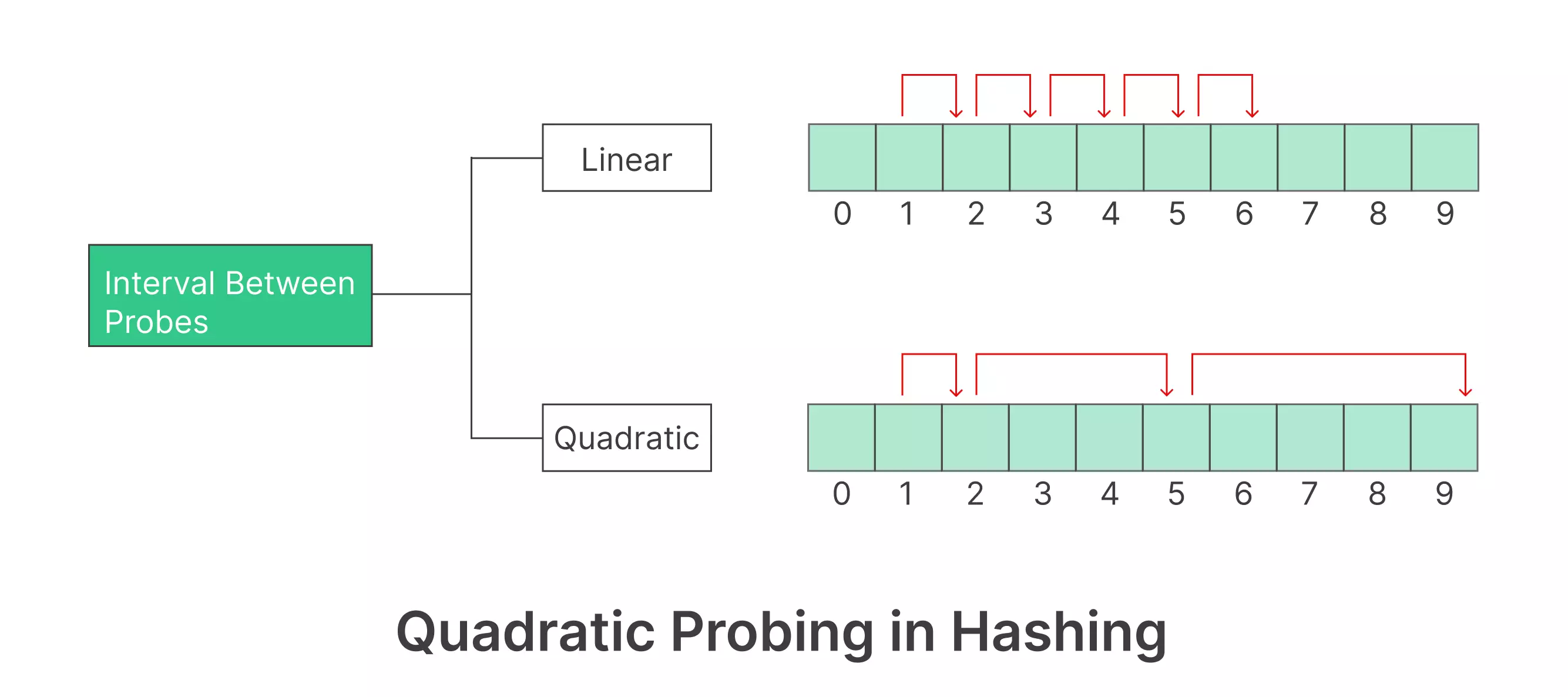
Explain Open Addressing and its different probing techniques.
Answer:Open Addressing is a collision resolution technique where a hash table dynamically looks for alternative slots to place a colliding element.
Probing Techniques
-
Linear Probing: When a collision occurs, investigate cells in a consistent sequence. The operation is mathematically represented as:
Here, is the key’s hash value, is the table size, and iterates within the modulo operation.
-
Quadratic Probing: The cells to search are determined by a quadratic function:
Positive constants and are used as increment factors. If the table size is a prime number, these constants can equal 1 and 1, respectively. This scheme can still result in clustering.
-
Double Hashing: Unlike with linear or quadratic probing, the second hash function computes the stride of the probe. The operation is:
Note: It’s crucial for the new probe sequence to cover all positions in the table, thereby ensuring that every slot has the same probability of being the data’s final location.
-
Complexity and Performance
- 11.
Explain the Time and Space Complexity of a Hash Table.
Answer:Hash tables offer impressive time and space performance under most conditions. Here’s a detailed breakdown:
Time Complexity
-
Best Case : With uniform distribution and no collisions, fundamental operations like lookup, insertion, and deletion are constant-time.
-
Average and Amortized Case : Even with occasional collisions and rehashing, most operations typically remain constant-time. While rehashing can sometimes take , its infrequency across many operations ensures an overall constant-time complexity.
-
Worst Case : Arises when all keys map to one bucket, forming a linked list. Such cases are rare and typically result from suboptimal hash functions or unique data distributions.
Space Complexity
The primary storage revolves around the elements in the table. Additional overhead from the structure itself is minimal, ensuring an upper bound of . The “load factor,” indicating the ratio of stored elements to the table’s capacity, can impact memory use.
-
- 12.
What is a Load Factor in the context of Hash Tables?
Answer:The load factor is a key performance metric for hash tables, serving as a threshold for resizing the table. It balances time and space complexity by determining when the table is full enough to warrant expansion.
Formula and Calculation
The load factor is calculated using the following formula:
It represents the ratio of stored elements to available buckets.
Key Roles and Implications
- Space Efficiency: It helps to minimize the table’s size, reducing memory usage.
- Time Efficiency: A well-managed load factor ensures constant-time operations for insertion and retrieval.
- Collision Management: A high load factor can result in more collisions, affecting performance.
- Resizing: The load factor is a trigger for resizing the table, which helps in redistributing elements.
Best Practices
- Standard Defaults: Libraries like Java’s
HashMapor Python’sdictusually have well-chosen default load factors. - Balanced Values: For most use-cases, a load factor between 0.5 and 0.75 strikes a good balance between time and space.
- Dynamic Adjustments: Some advanced hash tables, such as Cuckoo Hashing, may adapt the load factor for performance tuning.
Load Factor vs. Initial Capacity
The initial capacity is the starting number of buckets, usually a power of 2, while the load factor is a relative measure that triggers resizing. They serve different purposes in the operation and efficiency of hash tables.
- 13.
How does the load factor affect performance in a hash table?
Answer:The load factor is a key parameter that influences the performance and memory efficiency of a hashtable. It’s a measure of how full the hashtable is and is calculated as:
Core Mechanism
When the load factor exceeds a certain predetermined threshold, known as the rehashing or resizing threshold, the table undergoes a resizing operation. This triggers the following:
- Rehashing: Every key-value pair is reassigned to a new bucket, often using a new hash function.
- Reallocating memory: The internal data structure grows or shrinks to ensure a better balance between load factor and performance.
Performance Considerations
- Insertions: As the load factor increases, the number of insertions before rehashing decreases. Consequently, insertions can be faster with a smaller load factor, albeit with a compromise on memory efficiency.
- Retrievals: In a well-maintained hash table, retrievals are expected to be faster with a smaller load factor.
However, these ideal situations might not hold in practice due to these factors:
-
Cache Efficiency: A smaller load factor might result in better cache performance, ultimately leading to improved lookup speeds.
-
Access Patterns: If insertions and deletions are frequent, a higher load factor might be preferable to avoid frequent rehashing, which can lead to performance overhead.
Code Example: Load Factor and Rehashing
Here is the Python code:
class HashTable: def __init__(self, initial_size=16, load_factor_threshold=0.75): self.initial_size = initial_size self.load_factor_threshold = load_factor_threshold self.buckets = [None] * initial_size self.num_entries = 0 def insert(self, key, value): # Code for insertion self.num_entries += 1 current_load_factor = self.num_entries / self.initial_size if current_load_factor > self.load_factor_threshold: self.rehash() def rehash(self): new_size = self.initial_size * 2 # Doubling the size new_buckets = [None] * new_size # Code for rehashing self.buckets = new_buckets - 14.
Discuss different ways to resize a hash table. What is the complexity involved?
Answer:Resizing a hash table is essential to maintain efficiency as the number of elements in the table grows. Let’s look at different strategies for resizing and understand their time complexities.
Collision Resolution Strategy Affects Resizing Complexity
Resizing a hash table with separate chaining and open addressing entails different methods and time complexities:
- Separate Chaining: Direct and has a time complexity of for individual insertions.
- Open Addressing: Requires searching for a new insertion position, which can make the insertion in the worst-case scenario. For handling existing elements during resizing, the complexity is . Common heuristics and strategies, such as Lazy Deletion or Double Hashing, can help mitigate this complexity.
Array Doubling and Halving
Array resizing is the most common method due to its simplicity and efficiency. It achieves dynamic sizing by doubling the array size when it becomes too crowded and halving when occupancy falls below a certain threshold.
- Doubling Size: This action, also known as rehashing, takes time, where is the current number of elements. For each item currently in the table, the hash and placement in the new, larger table require time.
- Halving Size: The table needs rescaling when occupancy falls below a set threshold. The current table is traversed, and all elements are hashed for placement in a newly allocated, smaller table, taking time.
List of Add/Drop in Dynamic Table Resizing
- Resizing a dynamic list denoted as a table:
Operation Time Complexity Insert/Drop at the end O(1) Insert/Drop at any position O(1) Doubling/Halving O(n) Code: Array Doubling & Halving
Here is the Python code:
class HashTable: def __init__(self, size): self.size = size self.threshold = 0.7 # Example threshold self.array = [None] * size self.num_elements = 0 def is_overloaded(self): return self.num_elements / self.size > self.threshold def is_underloaded(self): return self.num_elements / self.size < 1 - self.threshold def resize(self, new_size): old_array = self.array self.array = [None] * new_size self.size = new_size self.num_elements = 0 for item in old_array: if item is not None: self.insert(item) def insert(self, key): if self.is_overloaded(): self.resize(self.size * 2) # Insert logic self.num_elements += 1 def delete(self, key): # Deletion logic self.num_elements -= 1 if self.is_underloaded(): self.resize(self.size // 2) - 15.
How can the choice of a hash function impact the efficiency of a hash table?
Answer:The efficiency of a hash table relies significantly on the hash function used. An inadequate hash function can lead to clustering, where multiple keys map to the same bucket, degrading performance to O(n), essentially turning the hash table into an unordered list.
On the other hand, a good hash function achieves a uniform distribution of keys, maximizing the O(1) operations. Achieving balance requires careful selection of the hash function and understanding its impact on performance.
Metrics for Hash Functions
-
Uniformity: Allowing for an even distribution of keys across buckets.
-
Consistency: Ensuring repeated calls with the same key return the same hash.
-
Minimizing Collisions: A good function minimizes the chances of two keys producing the same hash.
Examples of Commonly Used Hash Functions
-
Identity Function: While simple, it doesn’t support uniform distribution. It is most useful for testing or as a placeholder while the system is in development.
-
Modulous Function: Useful for small tables and keys that already have a uniform distribution. Be cautious with such an implementation, especially with table resizing.
-
Division Method: This hash function employs division to spread keys across defined buckets. The efficiency of this method can depend on the prime number that is used as the divisor.
-
MurmurHash: A non-cryptographic immersion algorithm, known for its speed and high level of randomness, making it suitable for general-purpose hashing.
-
MD5 and SHA Algorithms: While designed for cryptographic use, they still can be used in hashing where security is not a primary concern. However, they are slower than non-cryptographic functions for hashing purposes.
General Tips for Hash Function Selection
-
Keep it Simple: Hash functions don’t have to be overly complex. Sometimes, a straightforward approach suffices.
-
Understand the Data: The nature of the data being hashed can often point to the most appropriate type of function.
-
Protect Against Malicious Data: If your data source isn’t entirely trustworthy, consider a more resilient hash function.
-

%20--%3e%3csvg%20version='1.1'%20id='Слой_1'%20xmlns='http://www.w3.org/2000/svg'%20xmlns:xlink='http://www.w3.org/1999/xlink'%20x='0px'%20y='0px'%20viewBox='0%200%20101%20101'%20style='enable-background:new%200%200%20101%20101;'%20xml:space='preserve'%3e%3cstyle%20type='text/css'%3e%20.st0{fill:%23FFFFFF;}%20%3c/style%3e%3cpath%20class='st0'%20d='M80.1,90c0.7,0,1.2-0.6,1.2-1.4c0-0.8-0.5-1.4-1.2-1.4H14.8c-2.7,0-4.9-2.5-4.9-5.6V15.2c0-0.8-0.5-1.4-1.2-1.4%20c-0.7,0-1.2,0.6-1.2,1.4v66.3c0,4.7,3.3,8.5,7.3,8.5H80.1z'/%3e%3cpath%20class='st0'%20d='M91.6,11H66.1c-0.7,0-1.2,0.6-1.2,1.4c0,0.8,0.5,1.4,1.2,1.4h22.7L63,43.7l-20.7,1.7l-0.7,0.4L22.4,67.7%20c-0.5,0.4-0.6,1.4-0.2,2c0.4,0.6,1.2,0.7,1.7,0.3c0.1-0.1,0.1-0.1,0.2-0.3l18.6-21.4l20.7-1.7l0.7-0.4l26.2-30.2v26%20c0,0.8,0.5,1.4,1.2,1.4s1.2-0.6,1.2-1.4V12.4C92.8,11.6,92.3,11,91.6,11z'/%3e%3c/svg%3e)







%20--%3e%3csvg%20version='1.1'%20id='Layer_1'%20xmlns='http://www.w3.org/2000/svg'%20xmlns:xlink='http://www.w3.org/1999/xlink'%20x='0px'%20y='0px'%20viewBox='0%200%2044.5%2044.5'%20style='enable-background:new%200%200%2044.5%2044.5;'%20xml:space='preserve'%3e%3cstyle%20type='text/css'%3e%20.st0{fill:none;stroke:%23202020;stroke-width:1.498;stroke-linecap:round;stroke-linejoin:round;stroke-miterlimit:3.994;}%20.st1{fill:none;stroke:%23202020;stroke-width:1.498;stroke-linecap:round;stroke-miterlimit:10.005;}%20%3c/style%3e%3cpath%20class='st0'%20d='M11.4,28l11-11.5L33.1,28'/%3e%3ccircle%20class='st1'%20cx='22.2'%20cy='22.2'%20r='21.5'/%3e%3c/svg%3e)